Planning Your Route Across Asia
A route is the order you visit places in and the logic connecting one place to the next. Get the shape right first and the details — bookings, visas, budget — fall into place far more easily than if you try to fix them before the shape exists.
Start With Entry And Exit Points
Before anything else, fix where you fly into and where you fly out of. An open-jaw ticket — flying into one city and out of a different one — is what makes a long, linear route through several countries workable, because it means you never have to double back to your starting point just to catch a flight home. A standard return ticket, by contrast, pushes you naturally toward a loop, since you need to end up back where you began.
This single decision shapes the rest of the trip. An open-jaw ticket into somewhere like Bangkok and out of somewhere like Kathmandu, for instance, only makes sense if the overland route between them is realistic given your visas and your time. Decide this early, because rebooking flights after you've already built an itinerary around the wrong entry and exit points is far more expensive than getting it right at the start.
Choose A Shape For The Trip
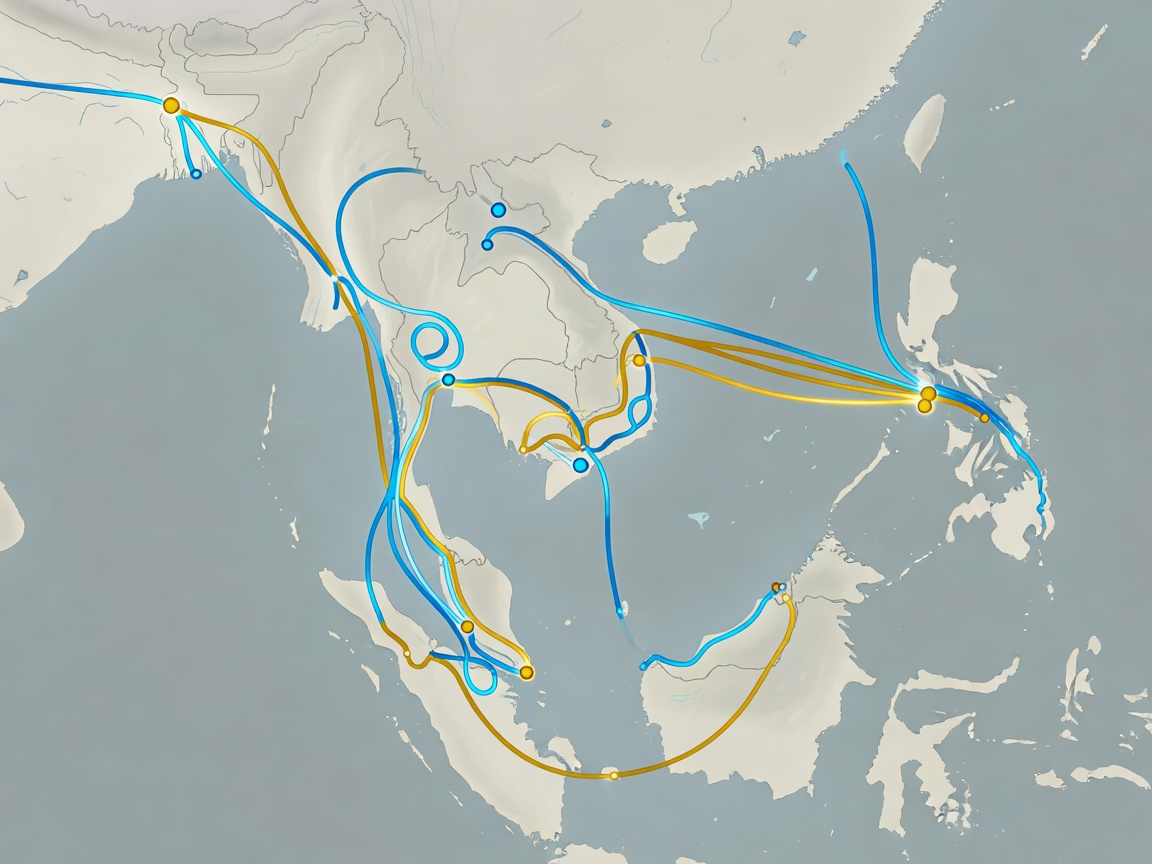
Three shapes cover most long Asia itineraries. A loop route returns to its starting point, which suits a single return flight and works well for a region like mainland Southeast Asia — a route through Thailand, Cambodia, Vietnam and Laos, starting and finishing in Bangkok, is a well-worn example of this shape. A linear or point-to-point route runs in one direction and needs an open-jaw ticket, which suits a corridor route such as Delhi through Rajasthan to Varanasi and onward into Nepal via Kathmandu. A hub-and-spoke route bases you in one city and makes shorter return trips out from it, which suits a single expensive or hard-to-reach base — Almaty or Bishkek as a base for exploring the wider Central Asian stretch of the historic Silk Road, including Samarkand and Bukhara, is one way this shape gets used.
None of the three is inherently better. A loop protects you from ever being stuck a long way from your flight home. A linear route covers more new ground for the same number of days, since you're never retracing a path you've already taken. A hub-and-spoke route reduces the number of times you have to pack up your whole life and move it, which matters more than people expect on a long trip.
Building The Route Step By Step
Once you know your entry and exit points and your preferred shape, build the detail in this order.
- Fix the outer limits first — total time available and the two or three regions that are realistic within it. Trying to cover Central Asia, Southeast Asia and East Asia in one trip almost always means seeing all three badly rather than any of them well.
- Sequence the regions by climate and visa validity before you sequence them by flight convenience. A cheap flight into the wrong region at the wrong time of year costs you more in wasted days than it saves in fare.
- Identify the specific land border crossings connecting your chosen countries and confirm, for your own passport, which of them permit the crossing you're planning. Not every border that appears on a map is open to every nationality, and some require a visa arranged in advance rather than on arrival.
- Block out your anchor points — the handful of cities, treks or sites you're actually committed to seeing — before you fill in anything else. Everything between anchor points is negotiable; the anchor points themselves usually aren't.
- Add a buffer day after any leg that involves an overnight bus, a border crossing, or a domestic flight with a tight onward connection. These are the legs most likely to run late, and a route with zero slack turns one delayed bus into a cascading problem.
- Leave the final week of the trip loose rather than fully planned. By that point you'll know which places were worth more time than you gave them and which weren't, and an unplanned week lets you correct for that instead of sticking rigidly to a plan made before you left.
Common Route Mistakes
The most frequent mistake is underestimating overland distance. A bus journey that looks short on a flat map can still take the better part of a day where the road climbs through mountains or the surface deteriorates outside a capital city — this is a real constraint across much of South and Central Asia in particular, and it's easy to miss when you're planning from a screen rather than the ground.
The second is ignoring visa validity windows when sequencing regions. A visa that grants a fixed number of days from the date of entry, rather than from a date you choose, effectively starts a countdown you can't pause, and a route that lingers too long in one country before entering the next can leave you no time at all in a country you'd already committed to.
The third is overpacking the itinerary itself — scheduling so many stops that every day becomes a travel day. A route with fewer stops and longer time in each one is almost always more satisfying than a route that maximises the count of places visited.
Revisiting The Plan While You're Away
Treat the route you build before departure as a first draft, not a contract. Talk to other travellers moving in the opposite direction — they're one of the most reliable sources of current, on-the-ground information about a border crossing, a road closure or a town that's turned out to be worth an extra day. Rebooking a bus ticket or an internal flight once you're already travelling is usually straightforward and often cheap; the sunk cost of a plan you made months earlier is not a good reason to stick to it if the trip itself is telling you something different.